

Object Study
The Armadillo: Look 4
An unfamiliar silhouette, made for Plato’s Atlantis. The Look 4 pair and its sixteen-year private history.

Introduction
The Armadillo boot gave Plato’s Atlantis an anatomy of its own. Its curved shell concealed the foot, carrying Alexander McQueen’s imagined future into the act of walking.
The ombré brown python pair worn with Look 4 remained in one private collection for sixteen years, before its placement through Three Over Six in 2026.
Plato's Atlantis
Between land and sea
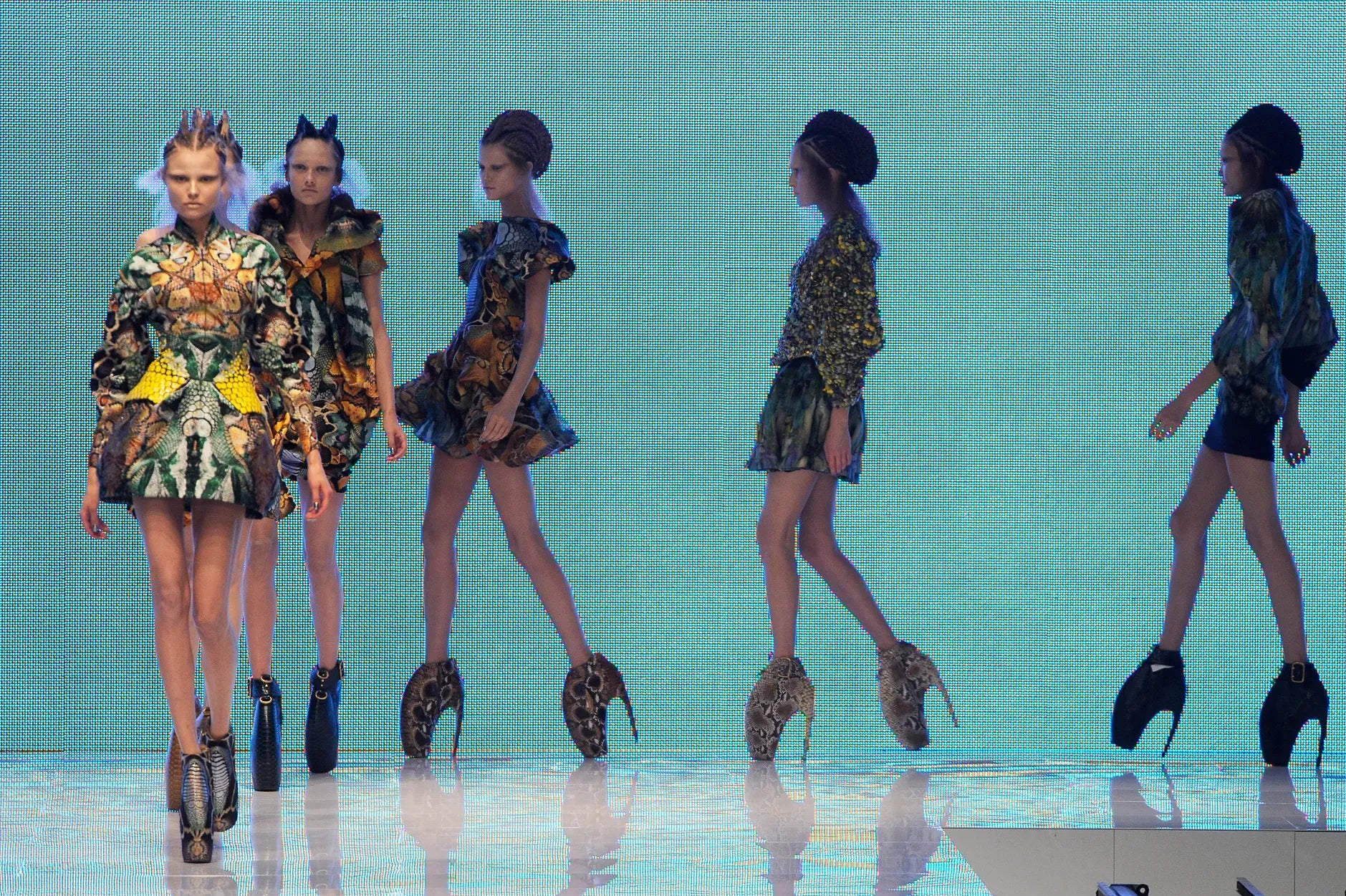
Presented in Paris on 6 October 2009, Plato's Atlantis was Alexander McQueen's Spring/Summer 2010 collection and the final fully realised runway presentation of his lifetime.
McQueen imagined a future in which rising seas returned humankind to life beneath the water. The collection followed that transformation through colour, texture and an altered anatomy.
Across the sequence, earthbound ochres and reptilian markings gave way to aquatic blues, iridescence and translucent surfaces. Engineered prints followed the cut of each garment, allowing image and construction to move as one.
Sculpted dresses altered the proportions of torso and hip. The Armadillo boots completed the transformation, extending the figure and concealing the familiar anatomy of the foot within a continuous outer shell.
Construction
The structure beneath the silhouette
Seen in profile, the Armadillo appears as an uninterrupted volume. An enlarged forepart, steep internal pitch and narrow rear heel form its high arch, while the outer shell conceals the ordinary divisions of foot, sole and heel.
Technical documentation published by the Victoria and Albert Museum describes a hand-carved wooden base with the lining and upper lasted separately. The lining and upper each close with two zips. A further wooden support above the toes assists the lifting of the forepart in motion.
McQueen’s concept was technically developed in collaboration with footwear designer Georgina Goodman, working from his brief that the models appear to stand en pointe and emerge from water.
- Original pairs
- 21
- Made for Plato's Atlantis in 2009.
- Later pairs
- 3
- Made in 2015 and offered through Christie's in support of UNICEF.
- Christie’s, 2015
- US$366,750
- Combined price realised for the three later pairs, including buyer’s premium; offered in support of UNICEF’s Nepal relief.
- Kerry Taylor, 2019
- £78,000
- Lot 261 — A fine and rare pair of Alexander McQueen ‘Armadillo’ boots
Passion for Fashion, 17 June 2019.
Calculated total from the published £60,000 hammer result, including the 25% buyer’s premium and 20% VAT on that premium.
On the runway
The fourth look
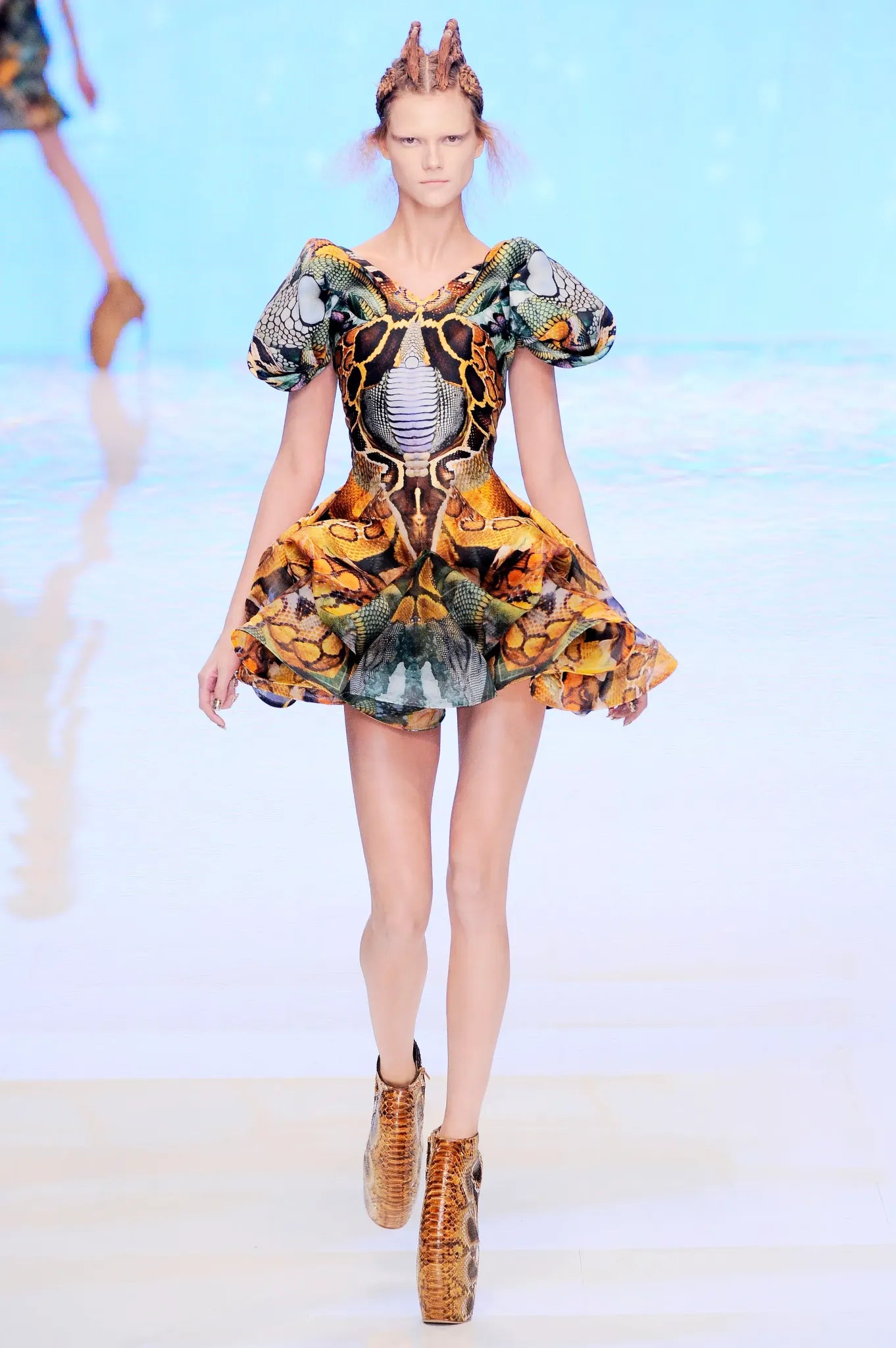
Modelled by Kasia Struss, Look 4 belongs to the collection’s earthbound sequence. Ochre, amber, cream and brown carry the reptilian pattern from dress to boots, resolving both as one silhouette.
The enlarged forepart balances the dress, while the high arch and narrow heel extend its line. The boot’s extraordinary proportions were conceived for the complete figure.
Profile study
The silhouette from both sides

The Look 4 pair, in opposing profiles. © Three Over Six
Provenance
A private history
The pair entered a private collection in 2010 and remained with the same owner for sixteen years. Following an international search, it was privately placed through Three Over Six in 2026.
Significance
How the Armadillo became an icon
Few shoes are recognisable from their outline alone. The Armadillo’s extraordinary curve carried McQueen’s vision beyond the runway, with exacting shoemaking beneath its alien form.
Lady Gaga’s Bad Romance video brought the collection’s iridescent closing look to a wider audience. Museum exhibitions gave the boots another life, as objects through which to explore McQueen’s imagination and craft.
The Metropolitan Museum of Art holds examples in snakeskin and turquoise shagreen. The design also became a defining presence in Alexander McQueen: Savage Beauty, at the Met and later the V&A.
The Look 4 pair retains its own place within that history: python, ochre and amber, from McQueen’s final fully realised runway collection.
Object record
Armadillo boots, Look 4
- Designer
- Alexander McQueen (British, 1969–2010)
- Object
- Pair of Armadillo boots
- Collection
- Plato's Atlantis, Spring/Summer 2010
- Presented
- 6 October 2009
- Materials
- Ombré brown python and mixed materials
- Runway
- Look 4
- Provenance
- One private collection, 2010–2026; sourced and privately placed through Three Over Six, August 2026
References
- Victoria and Albert Museum, Armadillo boot
- The Metropolitan Museum of Art, Armadillo boot
- SHOWstudio, Plato's Atlantis
- Vogue Runway, Alexander McQueen Spring 2010, Look 4
- Vogue, Alexander McQueen Spring 2010: Plato's Atlantis
- Alexander McQueen, The Armadillo Boot
- Christie’s, Handbags & Accessories, Armadillo boots: Lot 1, Lot 2 and Lot 3
- Kerry Taylor Auctions, Lot 261: a fine and rare pair of Alexander McQueen Armadillo boots